If the few hours I have spent playing Japanese dating simulation games have taught me anything, it’s that knowing a little something about the people you’re trying to impress goes a long way.
That’s why it shouldn’t be surprising that Microsoft’s PR company Waggener Edstrom had a dossier on journalist Fred Vogelstein, and it should be even less surprising that this dossier was being circulated when Vogelstein was conducting interviews for his article on blogging at Microsoft (a story that’s part of this month’s theme in Wired magazine — “Radical Transparency”).
What is surprising is that someone emailed Vogelstein’s dossier…to Vogelstein. Vogelstein posted the entire document online…
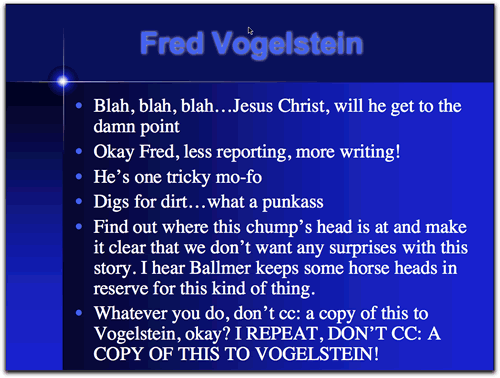
An imaginary briefing slide, based on actual content in Waggener Edstrom’s dossier on Fred Vogelstein.
I’ve got to hand it to Waggener Edstrom president Frank Shaw: he did a pretty good job spinning this accidental leak:
Now, let’s talk about the briefing mail now online and the mention in the article of a “confidential dossier of 5,500 words.” Not true – someone is confusing a briefing with a dossier and “confidential” with “not sent to me”.
…
Seriously, in this case, the interests of a journalist and PR are totally aligned – a great interview is always the best possible outcome. And that doesn’t mean an interview where a spokesperson endlessly repeats key messages – that’s a loss. It’s an interview where the person is prepared to talk, has the relevant data at hand, understands the story premise and his/her role, and doesn’t waste time going over the same territory as a previous interview.
 The New York-based company is using investment bank Morgan Stanley to help sound out its options, these people said, including a possible stock-market listing. The company is majority-owned by San Francisco private-equity firm Hellman & Friedman, which since purchasing DoubleClick in 2005 for approximately $1.1 billion, has sold off a number of divisions and reshaped the business. Hellman is seeking at least $2 billion for DoubleClick, said one person briefed on the situation, and it remains an open question whether the firm will choose to complete a deal.