From the monthly archives:

October 2007

SecTor Conference

by Joey deVilla on October 31, 2007

SecTor conference banner

If you’re interested in security and in the Toronto area on November 20 and 21st, the SecTor conference might be for you. Eldon Sprickerhoff tells me that it’s organized by TASK (Toronto Area Security Klatch). Although it’s a local grassroots effort, I’m told that they’ve corralled “a great group of speakers - basically, some of the best speakers from security conferences around the world” to speak at this event.

SecTor takes place on Tuesday, November 20th and Wednesday, November 21st and takes place at the Metro Toronto Convention Centre. Registration is CDN$950, and if you use the promo code “ESENTIRE”, you’ll get a 10% discount.


{ 0 comments }

Quick Book Review: Ruby by Example

by Joey deVilla on October 31, 2007

Cover of the book “Ruby by Example”If you’ve already got some programming experience under your belt and are searching for a book that’ll get you up to speed with Ruby very quickly, I strongly recommend Ruby by Example (written by Kevin Baird and published by No Starch Press, whose books on coding have impressed me).

As the book’s name implies, it covers the the Ruby programming language (with a little bit of Rails thrown in) through dozens of annotated examples, which covers not only the language but Ruby idioms as well. Experienced programmers will appreciate not being dragged through yet another set of introductory chapters (”this is branching…this is a loop…these are classes and objects…”). Any introductory material is saved for topics that might be new even to experienced programmers, such as chapter 6’s — Functionalism with Blocks and Procs — which may represent some of the best coverage of the topic in any Ruby book. (Even better, it’s available as a free sample chapter!)

Pair Ruby by Example with Agile Web Development with Rails (you could throw in Everyday Scripting with Ruby as a bonus) and you’ve got a killer combo for getting started with web development using Ruby.

{ 1 comment }

Cylon-O-Lantern

by Joey deVilla on October 31, 2007

Cylon-o-lantern

Happy Hallowe’en! If you’re feeling that your jack o’ lantern just doesn’t enough nerd oomph, Evil Mad Scientist Laboratories’ Cylon-O-Lantern might be what you need. Here’s a video of the Cylon-O-Lantern in action…


Can’t see the video? Click here.

{ 0 comments }

Automan!

by Joey deVilla on October 31, 2007

I’ve been tied up with all sorts of work- and life-related things, hence the lack of posts over the last few days.

By way of apology, allow me to offer the so-bad-it’s-good nerd TV show from the 1980s, Automan! Loosely based on the movie Tron and driven by the then-new interest in personal computers (this was the age of the original IBM PC and the Apple ][). It had all the earmarks of a cheesy Glen A. Larson production, plus all the technobabble of that era and made the old Buck Rogers series look like hard sci-fi by comparison.


Click here to see the video at full size.

{ 0 comments }

If You’re Happy and You Know It…

by Joey deVilla on October 24, 2007

Computer monitor: “If you’re happy and you know it, syntax error!”
Photo courtesy of Miss Fipi Lele.

{ 14 comments }

Google Translate’s Strange Results

by Joey deVilla on October 23, 2007

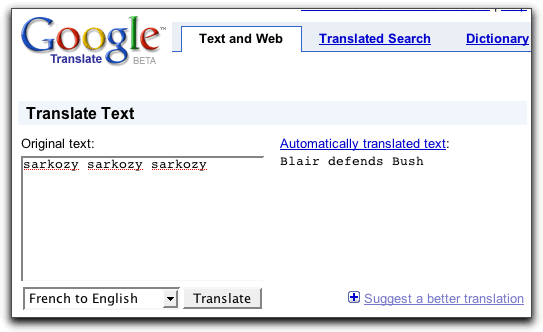
Here’s something pointed out by a guy on Reddit, who took his cue from an entry in the French blog Zorgloob: take a look what happens when you enter sarkozy sarkozy sarkozy (as in French president Nicolas Sarkozy) into Google Translate and select a French-to-English translation:

Screen capture of Google Translate’s French-to-English translation of “Sarkozy Sarkozy Sarkozy”: "Blair defends Bush"

Here’s some other input that yields interesting output:

Is it an Easter Egg by some politically-minded pranksters at Google? Or users abusing the “suggest a better translation” feature? Or a quirk of the way it translates, which one Reddit reader says is based on training by “feeding it documents which have been translated into many languages by the likes of the UN”?

{ 0 comments }

The REAL Reason GOTO is Considered Harmful

by Joey deVilla on October 23, 2007

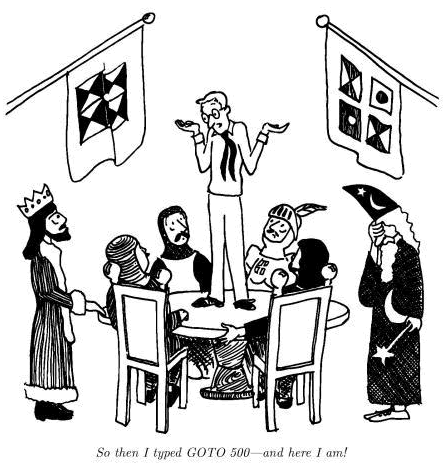
Man standing on a table in King Arthur’s court: “So then I typed GOTO 500″ — and here I am!
Comic taken from the book Thinking Forth.
Click the comic to see it in its original context.

(If you’re wondering why someone would GOTO a number, it’s likely that you’re too young to have worked with versions of BASIC that required line numbers. Consider yourself very, very, very lucky.)

Cross-posted to the Tucows Developer Blog

{ 0 comments }

Tim “Ongoing” Bray’s Take

Tim Bray posted a blog entry on what drives adoption of a language in which he included some tables such as the only below:

Flawed
Founders
Polished
Successors
Procedural FORTRAN, COBOL, PL/1 C
Object-Oriented C++ Java
Higher-Level Perl, TCL Python, Ruby

This table of his should inspire a monkey knife fight on a number of blogs:

Flawed
Founders
Polished
Successors
Web-Centric WebObjects, ColdFusion, ASP.Net, Struts, etc.,
etc., etc., PHP
Rails

Here’s an interesting one. What will JavaScript’s successor be? My guess for the short-term (by that, I mean “the next half-dozen or so years”) is “the next version of JavaScript”.

Flawed
Founders
Polished
Successors
Mobile-Code JavaScript ?

The one about concurrent programming is a little more up in the air. Although there are other languages designed with concurrent programming in mind (either from the ground up or with concurrency retrofitted onto an existing language) and there have been for a while (I used Concurrent C in a course back at Crazy Go Nuts University in the early ’90s), Erlang is getting a lot of the attention these days since it has both a success story at Ericsson under its belt as well the clout of a Pragmatic Programmers book behind it. There is a feeling among some programmers (Bray included) that it isn’t going to be the language to turn concurrent programming from arcane art into mainstream practice:

Flawed
Founders
Polished
Successors
Concurrent Erlang ?

Shelley “BurningBird” Powers’ Take

Shelley Powers disagreed with Tim’s assessments in her posts Flaws are in the Eye of the Beholder:

I find it fascinating when a person marks as ‘flawed’ the languages that have, literally, defined not only the web but application development of all forms. Perhaps the metric shouldn’t be on syntax, form, or function, but on usability.

Here’s her own table on languages:

'Perfect', but barely used 'Flawed', but simple, approachable, powerful, popular
Higher-Level *Ruby (every time I see 'Ruby' I mentally add, Mama's precious little…)

*I’m giving Python a slide because Python has fairly widespread use today.

Perl
Client side code (The to-be-created scripting language that will take a nice, clean, easy to use language and morph it until it satisfies the purists, while breaking faith with the millions of users just trying to do a job) JavaScript
Object Oriented Java (bloated beyond recognition with senseless additions and overly complex infrastructures) C++ (which can kick Java's ass performance and resource wise)
Web-Centric Rails (you know that thing they used for the one application?) Cold Fusion, ASP and ASP.NET, PHP

Those of you who recall Bjarne “C++” Stroustrup’s line “There are just two kinds of languages: the ones everybody complains about and the ones nobody uses” or the essay Worse is Better (or the essay that led to it or Jamie Zawinski’s commentary on it) should be feeling deja vu now.

As for Shelley’s table, I’d probably have put “PHP” where “Perl” is right now.

My Own Take

I think that right now, the “scripting languages” are stuck in something akin to “Three Stooges Syndrome”. That’s the disease where Mr. Burns from The Simpsons, being so old and frail, has so many diseases trying to get at him at the same time that they’re all “stuck in the door”. The doctors illustrated the syndrome with a model, shown below:

“Three stooges syndrome” from “The Simpsons”: All the germs and viruses are stuck in the door because they tried to get in all at once.

And since Tim and Shelley have their tables, I thought I’d make one too:

Scripting Stooge What’s Driving It
Perl Legacy: it was the original “duct tape of the internet”.
PHP Widespread adoption, drives a lot of apps, easy to program, easy to deploy.
Python Very readable, one of the 4 languages approved for use at Google (the others being C++, Java and JavaScript, according to Steve Yegge).
Ruby Ruby on Rails, which is a very nice framework from the web app developer’s point of view. That and maybe the fact that DHH is rather photogenic (although PHPer-turned-Pythoner Leah Culver could give him some competition).


Cross-posted to the Tucows Developer Blog.

{ 0 comments }

The Official Segway of the Midlife Crisis

by Joey deVilla on October 22, 2007

Ferrari-branded Segway

According to the Sybarites site, there’s a Ferrari-branded Segway:

Segway have teamed up with Ferrari to release a special limited edition version of their i2 Personal Transporter. Ferrari have used Segway’s as a transportation method around their Maranello factory for sometime now, the Segway PT i2 Ferrari Limited Edition comes in Ferrari’s signature color, red and features the Scuderia Ferrari logo at the base. It has a range of almost forty kilometers off one battery charge and can be easily stowed in the trunk of a car for longer journeys. It comes with a handlebar bag made of leather.

{ 0 comments }

Windows Startup Screens and Sounds, from 1.0 to Vista

by Joey deVilla on October 21, 2007

Here’s a YouTube video that shows all the startup screens and sounds for Windows, from version 1.0 up to the present. If they ever make a geek version of Koyanisqatsi or Baraka, they should include something like this:


Can’t see the video? Click here.

{ 0 comments }