Jazzers and Programmers (Nick Sieger)
Nick Sieger had two talks ready and put it to an audience vote. They could pick either:
- Pointless and Time — Wasting Things You Can Do with JRuby, or
- Jazzers and Programmers
As you can see by the title, the audience picked “Jazzers and Programmers”.
Experience the music! Carsten Nielsen put together a muxtape page where you can hear the samples of jazz that Nick used in his presentation.
You should also see Nick Sieger’s blog entry Jazzers and Programmers, which is his presentation in article form.
- Let's trace the evolution of Jazz
    1. Swing
        - A popular, easily accessible style
    2. Bebop
        - Miles Davis
        - A little less accessible
    3. Hard Bop
        - Addition of soulful, gospel r&b elements
    4. Free Jazz
        - Improvisation with minimal themes
        - Visceral emotional style
    5. Jazz rock / Fusion
        - Miles Davis (again!)
        - On the Corner
    6. Today
        - Postmodern jazz?
        - Jazz rendition of "Iron Man"

- Programming is on a similar path
    - C: like New Orleans hot jazz
    - Java: like swing? (Groans from audience)
        - Both are very accessible to the masses, mainstream
    - What's in the future?

- The basis of jazz is the rhythm section
- The bassist is typically in the center of the rhythm section
    - Responsible for both the harmonic foundation *and* beat
    - Often established using a walking bassline
- Piano and drums: comping (short for "acCOMPanyING")
    - In jazz, these instruments are more about creating sonic textures
- The rhythm section is analogous to a programming library, framework or pattern
- Bass/drums/piano == Model/view/controller

- Musical structures
    - In a jazz piece, it's typically head / solos / head
    - The theme is established in the head at the beginning
    - The solos are based on the theme, but each musician is free to improvise
      based on the theme
    - The closing head ties everything together
- The Real Book
    - A big book of sheet music of jazz standards notated by working musicians
      (without bothering to get the rights)
    - Allows musicians who don't normally play together to have a common
      point of reference
    - In a jam session, musicians call tunes out of the Real Book
    - It's essentially a "patterns book"
- This like common structures provides a common language and organic conventions
- There is no "W3C Committee"-like body that dictates how you play jazz
- It's all conventions established by musicans floating between bands

- Improvisation separates jazz from other styles
    - Ornette Coleman quote: "When I found out that I could make mistakes,
      I knew I was onto something."
    - The structures in jazz provide a framework that actually makes
      improvisation possible
    - Inronically, it's these constraints that free you

- Communication and persuasion
    - Improvisation is all about being convincing
    - It has a back-and-forth conversational element
    - It's a non-verbal kind of communication
    - Consider the act of "trading fours": that's where different musicians in
      a jazz combo take turns playing for four measures, "trading" back and
      forth with each other: perhaps sax 1 takes 4 measures, then sax 2, then
      the piano, then the drummer.

- Do programmers improvise?
    - The best programmers have a sense of spontaneity
    - Consider continual rewrites
        - Fred Brooks says "Plan to throw one away"
        - I say "Why stop at one?"
    - I like it when developers do live coding in front of an audience rather
      than doing it in advance and running it, or just showing a screencast
      of them coding
        - It's fascinating to see the process, especially when it's a good
          programmer doing live coding.
        - Jazz musicians make "mistakes" all the time, but they're not mistakes,
          they're the music
        - "Do not fear mistakes. There are none." -- Miles Davis

- Coding jam session
    - Musicians jam together; coders should too!
    - When commenting on a fellow jammer's code, think in terms of
      "Yes, and..." rather than "Yes, but"

- Jazz musicians and altered states
    - "Write the test cases when sober. Write the code when you're drunk."
Do the Hustle (Obie Fernandez)
From the RubyFringe program booklet:
Sales is an a rt that very few technical people have mastered. Very few. It takes patience, confidence, empathy and a whole slew of other skills mixed together — a brew that is seriously difficult for many geeks to figure out. In this talk, Obie will leverage his experience successfully selling consulting services for both Thoughtworks and Hashrocket to help you with the following questions: How do I figure out how to price my services? How do I figure out the kind of work I want to sell? How do I write contracts and statements of work? What about proposals? And RFPs? How do I close the deal?
- My formula: Get into programming, write a bestselling book,
  start consultancy, profit!
- I've had to make my own luck
    - I come from a humble background, with no prospects coming out of
      high school
- I landed my first job in IT in 1996
    - It was as a Java programmer
    - I read "Teach Yourself Java in 21 Days" and wore a nice suit to interview
    - I knew how to present myself
    - That's what I'm talking about today
- I'm talking about hustling!
    - This is not about scams or cons
    - It's about being able to jump on opportunities when they present themselves
    - The dictionary definition of "hustle" is to "obtain by forceful action
      or persuasion"
    - Yes, I do mean "forcefully"

- The sales cycle, which I will discuss, is made up of these phases:
    1. Marketing
    2. Qualifying
    3. Closing* -- ALWAYS BE CLOSING
    4. Maintenance

    - Marketing
        - Take a holistic approach
        - Looking good is a must: often it's what makes or breaks you
          when trying to get other people to "buy into you"
        - Your site/blog is your face -- make sure it looks good!
        - HashRocket logo:
            - Based on the "=>" is hashes
            - $15K for design work
            - Worth it, because it's gorgeous
            - Don't cheap out on your visual identity!

        - Have business cards
        - Having a business card determines whether or not you have a
          sales conversation -- if you've got a card, it's much easier to
          start one that has a hope of converting
        - Your website is like a business card: it should have correct
          and complete contact info
        - Having a phone is very important, and having the phone number on
          your site is also very important!
        - We got a lot of customer call within a day of posting
          our phone number on the site -- we tripled incoming sales contacts!

        - Encourage word of mouth
            - Read "Never Eat Alone|
            - Be altruistic and help people, do favours
            - "Seed the interactions that lead to good word-of-mouth"

    - Qualifying
        - Narrow down your offerings by defining products -- don't
          "just develop software" in a vague sense
        - Give yourself constraints
        - One great constraint to have is a minimum billable rate
        - Leads should not be qualified by the ultimate decision maker

        - Defining success
            - You can't rush the sales process
            - Ask yourself this question: Is the team prepared to fulfill
              or exceed the project requirements? If not, don't take it on!
            - Determining success criteria involves getting to know the
              prospective client via conversations. These can be face-to-face,
              or online, but you must get to know them!
            - Your own success criteria should remain constant
              -- write them down!

    - Closing
        - Use master service agreements with attached
          statement of work documents
        - These are easy to get client to sign up for, since they
          have no monetary component
        - Once someone signs this, they're the client!
        - Separate deliverables into "type A" and "type B"

        - Learn to negotiate!
        - You're worth more than you think
            - Average rate of $150/hr
            - See "Predictably Irrational" by Dan Ariely

    - Client management
        - Do remarkable work
        - Read "Purple Cow" by Seth Godin
        - Don't fear your clients -- make them fear you!
            - Not in a bad, trembling way
            - Make them afraid they can lose you if they misbehave
            - Client yelling at you: grounds for firing the client
                - Yes, you can fire a client!
Being Dumb and Using it to Your Advantage (Matt Todd)
From the RubyFringe program booklet:
You’re in over your head, dumber than you (and others) think, and you want to matter to your community. What do you do?
There are many good developers in this same position sitting on some dumb ideas simply because they are dumb. I’m challenging you to implement them…let me tell you why. First hand experiences from some dumb developer.
- I'm a nobody
- Contributed very little

- Lacking good judgement is not a bad thing all the time
- Be open to doing things that may seem a little ridiculous
- We are too smart for own good
- Tons of ideas bad in long run good in short run
    - Canvas for PHP
    - Building from scratch: a stretching experience

- From doing dumb things: taking chances, making mistakes and taking chances, you get:
    - Code
    - Confidence
    - Experience
- "Don't let your good judgement get in the way"

- What I learned from Halcyon
    - Anything can happen
    - A lot of tech things, maintaining a project openly, you don't combine an app,
      server and framework all together
    - I "don't want to fail to connect"

- Challenge!
    - Ideas sitting around the back of your head -- take 'em out! Work on 'em!

- Advice
    - Set yourself up for good problems (such as too many people using your app)
    - Set goals (including "make it work")
        - These goals don't have to be time-based

- "Creepy eyes! The end!"
The Framework Mass Index: Why Your Web Framework Sucks and You Should Build Your Own (Jeremy McAnally)
From the RubyFringe program booklet:
Frameworks are getting fat. Many times it’s just as easy to build your own stuff that does what you want rather than shoehorning what you want into an existing framework. This talk will discuss experiences in shoving specific functionality into a general framework and some options for curing the problems that were encountered.
- Pete Forde: "It's pronounced Mack-uh-NAL-lee."

- They told me to come here and drop a brain bomb
- I'm going to present what is "just a bunch of old ideas that need to be repeated"

- Beased on Obie's earlier talk, I checked our site and realized that our contact
  page is broken. That's probably why he haven't gotten any new work in a while.
- I'm starting a new project -- a magazine called "The Rubyist", which needs writers,
  editors and so on. If you're interested in contributing, we want you!

- Main point: Keep your framework within its domain
- I like Rails
- I like like Merb (except for 413 gems)
- But frameworks are getting fat
- "We're suffering from framework envy"
- There are 13,000 classes in .NET
- There are 13 web frameworks for Ruby
    - Rails has 521 classes
    - Merb has 400
- BMI: Body Mass Index
    - A measure of obseity based on a weight-height ratio
    - Not necessarily the best measure: Tom Cruise is obese, if you go by BMI
    - Maybe the equivalent for BMI in frameworks is WTFs/poung
    - Comparing the WTFs/pound in frameworks:
        - Merb has 16,000 WTFs/pound
        - Sinatra has 7 WTFs/pound
        - Rails has 12 quatrillion Heinemeiers
        - And Camping just has "true"

- Domain Specificity
    - Cruft is getting in the way
    - Have we forgotten YAGNI?
    - LOL AGILE
    - wxWidgets is a framework that's good at GUI
    - .NET is a framework that's good at...?
    - Rails is a framework that's good at database backed, front end driven
      web apps
    - Rails is not good at federated web apps
    - Integrating legacy systems with Rails is a pain

- Don't molest a framework
    - Problem: Ruby is a hacker's language, and hackers love to hack
    - You can open up a class and mess with it
    - This is okay, unless it's bad:

    - 3 things to consider when making your own framework for a specific
      domain
        1. Joy vs pain ratio when it fails
            - Does it take too much code to make things happen?

        2. Wrench meet mail
            - Are you using the right tool for the problem?

        3. Conventions rock
            - Favour conventions, be consistent!

    - Tools at your disposal:
        - Rack -- framework for writing frameworks
        - merb_core (if you need a little more fanciness)

- Use common sense: Don't hack a framework for the sake of hacking!
There Will be Porn (Zed Shaw)
From the RubyFringe program booklet:
I’ll go through 10 truly horrible ideas that I’ve implemented or thought about, all created just for RubyFringe.

- Pete: Don't be put off by that "AUGGGGGH!" stuff on his blog...
  he's really a super-nice guy

- GWAR-riffic intro song (available at his site)

- This is the best conference!
- Small conferences are the best; the giant conferences suck

- This is my Ruby retirement
- I will not be back. No more Ruby code. No more Ruby conferences
- WorkingWithRails.com -- if you're worried about your popularity on this site,
  you're a whore
- I'm currently writing a book, "How to build the greatest ruby server ever"
- I'll also be writing a book after that: "Protocols and performance"
- I consider myself an observer and an "anti-pundit"
- And now, my ideas!

- Idea #1
    - To-do lists are hot
    - Porn is even hotter
    - Social networks are hottest!
    - I combined them
    - Imagine a giant todo list. Just one, where everybody just adds to it.
      And at the same time, you upload porn!
    - You get everyone's to-do lists and everyone's porn

- Idea #2
    - Pornmagnet.tv
    - Imagine Miro but with all the free porn uploaded and ready for you!
    - One-handed operation
    - If you can't be a chick magnet, be a porn magnet

- Idea #3, which I actaully might just implement
    - chaos2congress.us
    - It hate politicians of all stripes. I want to get rid of all of them
    - Maybe I'll start by just removing incumbents. I want to fuzz incumbents.
      Let's pick a random guy and make his day bad
    - The website would list all memebrs of congress members
    - People could leave short statements about any member of congress
      that would "kick 'em in the nuts"
    - The top-rated and verified statments would be collected
    - Based on those, the site would automatically launch a war-dial campaign to
      "fuck up that senator's day"
    - "Oh wow, I'm so not getting back into the US"

- I'm so tired of making web applications
- I put together some code to help me play some "fucked up songs"
- The result: Inculcator
- Just PyGame and Ecasound
- Didn't take long to make

- I've got T-shirts!
Zed devoted the rest of the presentation to his Ruby “swan songs” — four numbers which he constructed on stage using Inculcator to record tracks and the salmagundi of music and computer gear shown in the photo below:
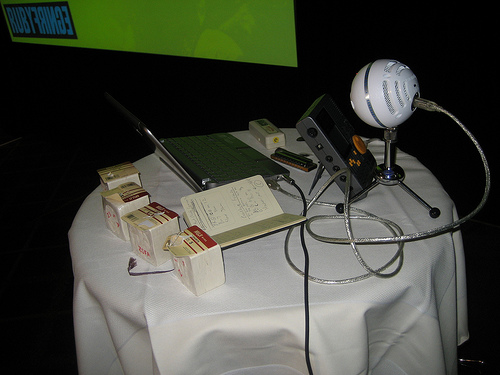
Zed’s gear consisted of:
- Traveler guitar
- Boss “Dr. Beat” DB-90 metronome/guitar preamp
- “Snowball” microphone by Blue Microphones
- and a subnotebook laptop that I can’t identify.
The four numbers he constructed and performed were:
- Zed Jumped the Shark (940K MP3)
- Matz Can’t Patch (1.7MB MP3)
- Don’t Fuck Up Chad’s Community (2.1MB MP3)
- Goodbye Friends (3.6MB MP3)
You can download them by clicking on the links above or by visiting their Internet Archive page, where you’ll find them in various formats. Zed put them in the public domain — in his own words: “I’ll nevermanke any money off them.”
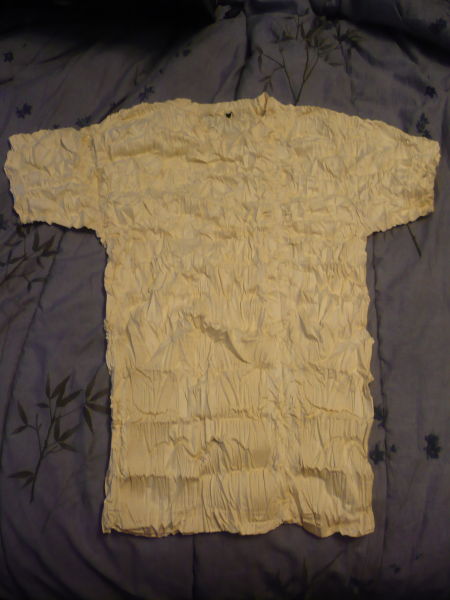
In the photo of Zed’s setup, you can see four boxes on the left side. They’re t-shirts which have been compressed into cubes. Zed customized them by hand-painting “ZSFA” (short for “Zed’s So Fucking Awesome”, the name of his blog) on them. They were rewards given to people who supplied the vocal samples (“Zed jumped the shark”) for Zed Jumped the Shark. Those people were: Hampton Catlin, Deb, one unidentified person and Yours Truly.
Here’s what the t-shirt looked like after I extracted it from its cube:
For Zed’s perspective on the event and his presentation, see his article titled RubyFringe 2008 – Killing Floor in Toronto.